How Can You Obtain an NIE in Spain through Investment or Entrepreneurship Via the Correct Legal Route?
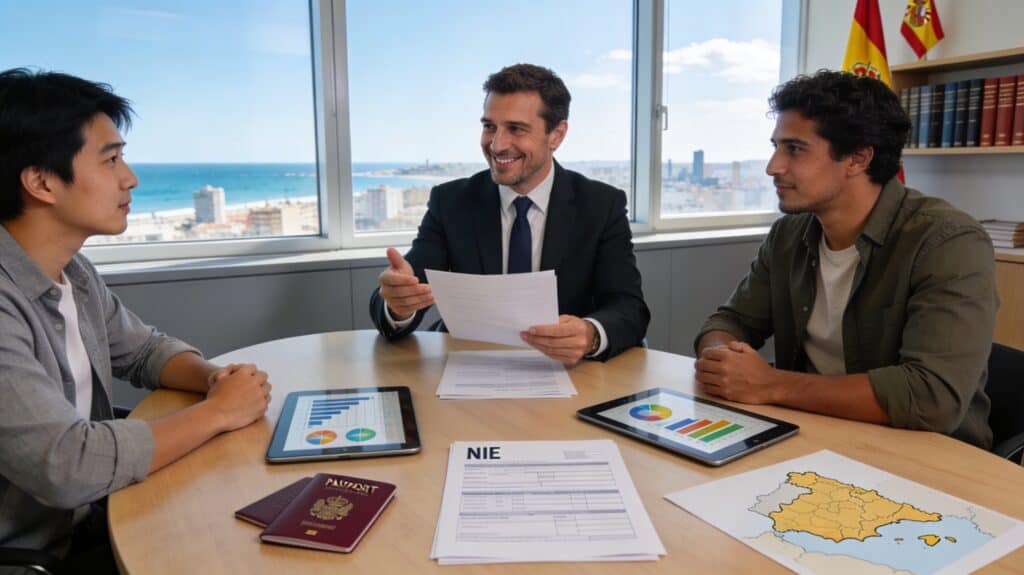
Many people have written to us because they want to know how to obtain an NIE in Spain through investment or entrepreneurship, and we have noticed that behind this query there is a broader and more important question. Beyond obtaining a number, the real issue is choosing the right application route from the very beginning. This is where things need to be put in order, because not every investment opens the same doors, nor is every business treated in the same way in legal terms.
WHAT DOES IT REALLY MEAN TO OBTAIN AN NIE IN SPAIN THROUGH INVESTMENT OR ENTREPRENEURSHIP?
When you contact us to ask how to obtain an NIE through investment or entrepreneurship, in reality, many of you are actually looking for an authorisation that allows you to enter Spain, reside there and carry out an economic activity. The NIE is the Foreigner Identification Number, but on its own it is not the same as a visa, a residence authorisation, a residence and work authorisation, or indeed the Foreigner Identity Card when that is what you are really trying to obtain. It may seem like a minor distinction, but in practice it completely changes the strategy behind the application.
Moreover, this type of search now tends to involve an additional source of confusion. The word investment still carries a great deal of weight online, but it should not simply be mixed together with authorisation for an entrepreneurial activity. In fact, the official information published by the Large Companies Unit reflects a very significant change in the regulation of investors under Law 14/2013, which makes it even more important not to confuse passive investment, ordinary self-employment and innovative entrepreneurship. In other words, putting money into a project does not automatically turn an idea into an entrepreneurial project for immigration purposes.
WHEN DOES THE ORDINARY ROUTE THROUGH THE CONSULATE APPLY, AND WHEN DOES THE ENTREPRENEURS ACT APPLY?
We believe this is the key point. If your idea involves an ordinary business or professional activity, the correct legal route will usually be the initial residence and self-employment work authorisation for a foreign national who is not resident in Spain. Spanish law is specifically designed for carrying out a self-employed profit-making activity, and it requires compliance with the applicable sector-specific rules, proof of your qualifications or experience where necessary, and evidence that the planned investment is sufficient. It is a serious and perfectly valid route, but it follows the logic of self-employment or a conventional business, not that of innovative entrepreneurship.
That is why, when we talk about applying from your country of origin through the Spanish consulate, we are not talking about a second-rate option, but rather the correct route for a great many projects. A shop, a traditional professional activity, a small service-based business or a business without a clear innovative component will usually fit better here than under Law 14/2013. And we can assure you that this matters a great deal, because trying to force an ordinary project into the wrong legal route usually means wasted time, poorly focused documentation, and unrealistic expectations from the outset.
The truth is that the Entrepreneurs Act works on a different basis. Both the legislation itself and the official information from the UGE start from the premise that the entrepreneurial activity must be innovative and/or of particular economic interest to Spain, and that this must be assessed specifically through a favourable report. In current practice, moreover, the authorities place this assessment in the sphere of ENISA and make something very important clear: there are no minimum investment or job creation thresholds which, by themselves, open up this route. What matters is not how much money you wish to invest, but what project you intend to develop and why it deserves to be treated differently from the ordinary route.
WHAT TYPES OF PROJECTS MAY BE BETTER SUITED TO LAW 14/2013?
From what we have observed in our professional practice, when a project has a technological basis with growth potential, a distinctive value proposition or a clear contribution to the Spanish economy, the situation changes considerably. The official assessment looks at the professional profile of the entrepreneur, the business plan and the added value the project may generate, and the legislation also stresses job creation and investment opportunities as factors of particular relevance. For that reason, in practical terms, scalable and digitised models usually present a stronger technical narrative when they are not simply another business or a mere intermediary for already established services, but instead introduce a solution with genuine scope of their own.
In this context, and purely by way of illustration, one may find SaaS solutions, automation tools, applied artificial intelligence platforms, digital health projects, cyber-security, educational technology, proposals linked to clean energy, smart mobility or advanced industrial technologies. However, you should be clear that merely mentioning one of these sectors does not mean the application is won, nor does it automatically mean the legal requirements have been met. What is assessed is not the sector “label” attached to the investment, but the real consistency of the project, its degree of innovation, the position of the applicant and the specific contribution that can actually be demonstrated.
WHAT MISTAKES OFTEN CAUSE A PROJECT TO START OFF WEAKLY?
The most common mistake is conceptual. Many people think that entrepreneurship simply means setting up a company, renting premises or registering as self-employed, and from there they try to fit the case within Law 14/2013. However, entrepreneurial activity under this route is not defined by the mere desire to start a business. In other words, you should not think of entrepreneurship in the everyday colloquial sense, but rather in terms of the innovative nature and/or particular economic interest of the project that is going to be assessed. When that foundation does not exist, the application has very limited prospects of succeeding.
Generic projects are also often refused, as are business plans built on grandiose but barely verifiable statements, or proposals which speak of a huge investment opportunity without convincingly explaining why the activity offers anything genuinely different. Another common mistake is to treat investment as a stand-alone argument, as if contributing capital were enough to turn an initiative into innovative entrepreneurship. It is not. The official guidance itself distinguishes between these concepts and makes it clear that the key to this authorisation does not lie simply in injecting a large amount of money into something, but in the technical and strategic quality of the project.
HOW SHOULD YOU PREPARE THE STRATEGY PROPERLY BEFORE SUBMITTING THE APPLICATION?
In our view, the sensible approach is to start with an original idea and a genuine activity, not with a catchy name and fashionable tech labels. First, you need to decide whether you are dealing with an ordinary self-employed activity or with a project that can genuinely be defended as innovative and of particular interest. Then the plan must be structured from an immigration-law perspective, not just a commercial one, clearly explaining what you do, how it is viable, what your professional role is, and why the route chosen is legally appropriate. Only then does it make sense to prepare the documentation, review the sector-specific requirements and submit an application.
This prior assessment is the part that offers the greatest protection to the application. It helps identify in time whether the case should be directed towards the ordinary self-employment route from the country of origin or whether it is truly worth pursuing under Law 14/2013. It also makes it possible to correct an overly vague business plan, refine the project narrative and avoid the classic mistake we have mentioned: presenting a promising idea with a documentary structure that proves nothing.
Under the international mobility route, moreover, the application is processed electronically through the Large Companies and Strategic Groups Unit, and the law sets a maximum decision period of twenty days for these authorisations, so arriving properly prepared is no small matter.
If you are considering starting a business in Spain, the right question is not simply how to obtain an NIE, but which route genuinely supports your project and what its legal basis is before you take the first step. If you would like to assess your case carefully and choose the right strategy from the outset, we will be delighted to help you, and we encourage you to CONTACT US.”