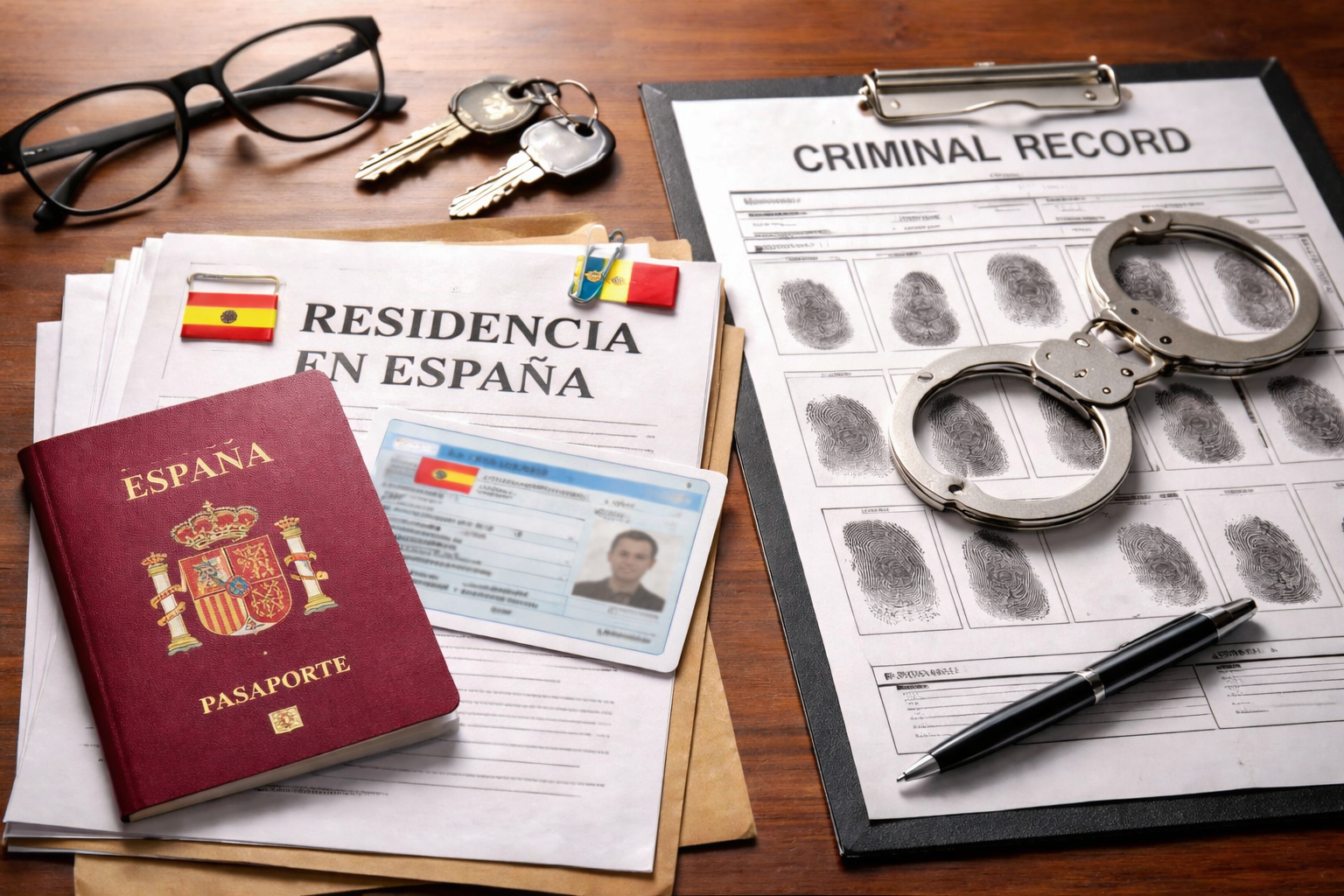
Criminal Records Abroad and Residence In Spain
Greetings, readers. When you consider living in Spain with a residence permit or a long-stay visa, the conversation usually revolves around work, studies, “arraigo” (residence on exceptional grounds) or family. Until the document appears that can block everything—and that almost nobody prepares in good time: the criminal record certificate from your country of origin or from your previous countries of residence. In practice, many applications get stuck or refused not because of the life plan, but because of a document that is incorrectly issued, incorrectly legalised, incorrectly translated, or impossible to reconcile with your actual history.
WHY DO THEY ASK FOR CRIMINAL RECORDS IF YOU WANT TO LIVE LEGALLY IN SPAIN?
Because, to grant temporary residence, the law requires that you have no criminal record in Spain or in your previous countries of residence for offences that exist under the Spanish legal system. This is not a bureaucratic whim; it is a public order and security filter. Royal Decree 1155/2024, of 19 November (hereinafter, the Regulations) develops this requirement across multiple procedures, repeating the same central idea: absence of criminal records in Spain and in the country of origin or in the countries where you have resided during the last five years.
WHAT DOES SPAIN MEAN BY HAVING NO CRIMINAL RECORDS, AND WHY DOES IT SET FIVE YEARS?
In many procedures you are asked to prove the last five years in the country of origin or in the countries where you have resided, because that is the time window used by the Regulations in various cases. Moreover, it is not enough that, in your country, the record has “expired” socially. Spain usually looks at whether there is a conviction for acts that would be an offence in Spain, as the rule refers to offences provided for in the Spanish legal system. This has a direct implication: two different certificates may say similar things, but one may be usable and the other may not. For example, a certificate that lists arrests without a court decision may raise doubts, whereas a certificate that shows absence of convictions or includes the final decision is usually more defensible.
WHICH DOCUMENT IS ACCEPTABLE IF YOUR COUNTRY DOES NOT ISSUE A STANDARD CRIMINAL RECORD CERTIFICATE?
The regulations themselves allow for a criminal record certificate or an equivalent document. That opens the door for a police clearance, a certificate of good conduct, or a mixed document to be accepted, provided it enables an assessment of whether there are convictions relevant to Spanish public order. Here it is worth being realistic, because you cannot decide equivalence yourselves; in practice, it is decided by the case officer. That is why the clearer the document is about convictions and about the period covered, the better.
HOW IS THE FOREIGN CERTIFICATE LEGALISED OR APOSTILLED SO THAT IT IS VALID IN SPAIN?
For a foreign certificate to have effect in Spain, it normally must be apostilled or legalised, depending on the issuing country. The Hague Apostille Convention replaces diplomatic legalisation between signatory countries. If the Apostille does not apply, consular diplomatic legalisation is used. And in immigration matters, the Administration also reiterates this requirement—legalisation and translation as applicable—as part of the correct submission of foreign documents.
The important thing is to follow the correct order. First, you need the right document; then, its apostille or legalisation. Finally, if it is not in Spanish, you obtain a sworn translation. If you do it the other way round, you could end up paying twice for a document that will not be valid.
WHEN DO YOU NEED A SWORN TRANSLATION, AND HOW DO YOU AVOID ERRORS WITH NAMES AND DATES?
As mentioned, if the certificate is not in Spanish, you will normally need an official translation. That is what a sworn translator or interpreter is for. For your peace of mind, whenever necessary you can use our partner company, En Otras Palabras; professional translators with extensive experience across multiple sectors.
In this respect, the mistakes that do the most damage are not usually legal ones, but simple issues of documentary consistency: when your given names and surnames appear in different variants between the passport, the certificate and the translation; when your date of birth or document number is transcribed incorrectly; when periods of residence are incomplete and you provide only one country despite having lived in two; or when the certificate itself does not clarify whether it refers to final convictions or merely police incidents. If, in addition, your country issues it in a poor or ambiguous format, the most robust way to safeguard the application is usually to accompany it with court decisions, supplementary certificates or official clarifications—always respecting the correct chain of legalisation or apostille and the sworn translation where required.
WHAT HAPPENS IF YOU HAVE AN OLD CONVICTION, A DISMISSED CASE OR POLICE RECORDS?
In this scenario, three situations must be distinguished.
- First situation: where there is a final conviction. The risk exists, and it will not disappear no matter how much we rely on ambiguous documents. If the foreign certificate shows convictions, the Administration may consider there is a threat to public order or security and issue a reasoned refusal. In these cases, the strategy is not to hide the information, but to carry out a proactive analysis of the circumstances: what the offence was, when it occurred, whether it is extinguished, whether there is rehabilitation or expungement in your country, and how it fits within Spanish law. There is not always room to manoeuvre, but sometimes there is—and the work is done with evidence.
- Second situation: there is a case that has been dismissed or an acquittal. The problem is that in some countries the certificate does not clearly distinguish between arrested and convicted. If you have a dismissal or acquittal, try to obtain the judicial document proving it, because it will allow you to explain the context with objective facts.
- Third situation: the existence of police records. Although they do not amount to guilt in a judicial sense, they can trigger suspicion. In Spain, even for internal police data, deletion requires final court decisions and proof that the proceedings have ended. That logic can guide you as to the type of evidence most likely to remove any doubt.
If you cannot provide a final decision, you must assume that the file will be more demanding and that the drafting of the written submissions and the selection of evidence will become a critical step.
HOW DOES ALL THIS AFFECT RENEWALS AND SPANISH NATIONALITY LATER ON?
For residence purposes, the starting point is always meeting the immigration requirements, and the foreign certificate is common in initial authorisations and in some cases of exceptional circumstances. For nationality by residence, the focus changes. You must show good civic conduct and sufficient integration, and the Administration may refuse on grounds of public order or national interest.
This means that, even if you manage to reside legally, a poorly handled criminal episode or a contradictory document can resurface when you apply for nationality. If you want a long-term plan, do not think only about getting through the first procedure; think about building a coherent documentary record.
WHAT PRACTICAL STRATEGY MOST REDUCES THE RISK OF REFUSAL FROM THE OUTSET?
To reduce risks from the outset, we recommend calmly reviewing your residence map for the last five years and requesting certificates from all the countries from which they may require them, not only from the country whose passport you happen to have to hand. Also, check whether the document shows convictions, police incidents, or both, and, where appropriate, prepare evidence of dismissal or closure of proceedings. It is also important to ensure you comply with the formal chain required for the document’s validity—apostille or legalisation and sworn translation where applicable; and avoid improvising with deadlines, because some certificates take weeks to be issued and then have to be legalised and translated; and if there are real records, address the case before making other submissions, because submitting quickly is not the same as submitting properly.
If your aim is to reside legally in Spain with the lowest possible risk, the sensible approach is to audit your foreign criminal documentation from the start, before choosing the procedure and the timetable. If you would like us to review your case and help you prepare a solid application from the outset, you can contact our team via our contact page and we will tell you which certificates you need, how to submit them correctly and which strategy best fits your situation.