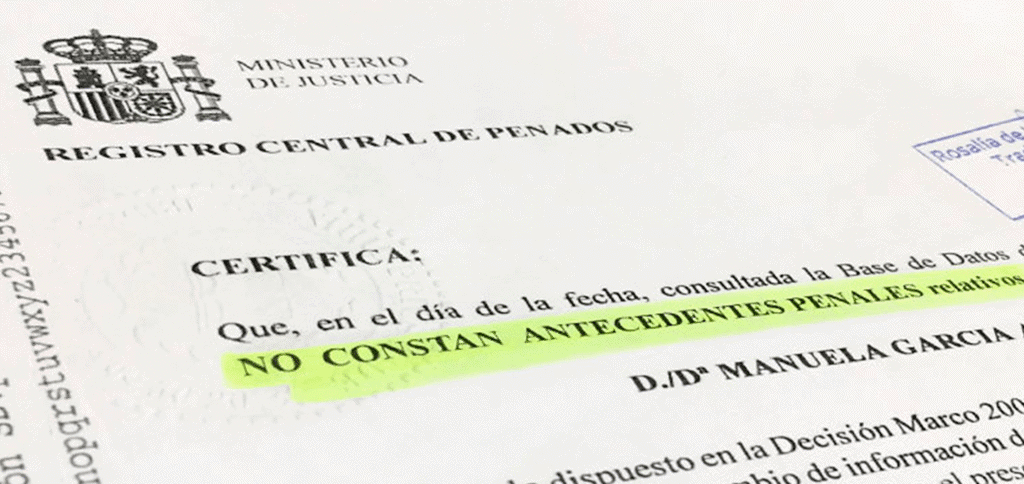
Immigration in Spain. Criminal Records and Certificates to Avoid Requests for Further Information
Greetings, readers; in many immigration procedures in Spain, criminal record certificates become the first administrative hurdle when the rest of the application is in order. If you have lived in more than one country, if you alternate stays for work or study, or if you are handling the application via a family route, the usual risk is not so much having a record as submitting a certificate that is incomplete, incorrectly dated, or lacking the form of international validity that the Administration expects.
WHY ARE CRIMINAL RECORDS A CRITICAL POINT IN IMMIGRATION MATTERS?
In immigration procedures, criminal records are used as an indicator of suitability and of risk to public order, and that is why the Administration tends to treat this document as a structural requirement rather than just another document. This explains why a “nearly correct” certificate frequently leads to a request for further information, and may even block the decision if it is not remedied in time. It is worth assuming from the outset that the certificate will be read using very strict formal criteria, both as to its content and as to its chain of authenticity and translation, where applicable.
It is also important to distinguish between what is requested in Spain and what is requested abroad. In Spain, if you are asked to prove the absence of a criminal record within Spanish territory, the logic is that of the corresponding state register. By contrast, when you are asked to provide records from other countries, the focus shifts to the document’s international traceability and to proving that the certificate covers what the case officer understands it should cover, with no temporal or geographical gaps. In family-based applications, moreover, any inconsistency between residence dates, municipal registration, visas or stay permits can trigger doubts on the Administration’s side, even if the underlying situation is capable of being regularised.
That said, there is a key nuance to bear in mind. The specific requirement will depend on the procedure, the competent body and your personal circumstances. Not all procedures ask for the same thing, and not all offices apply identical criteria in borderline cases. Ultimately, the aim is to prepare your documentation so that it remains defensible.
HOW IS THE “LAST FIVE YEARS” CRITERION INTERPRETED IN PRACTICE?
The “last five years” criterion appears frequently in immigration files and, when applied, it is usually linked to the idea of providing certificates from the countries where you have resided during that period. A clear example is the publicly available information for certain procedures that require you to have no criminal record in Spain and in the countries where you have resided within that timeframe.
However, it is best to treat that timeframe as a common practical reference, not as an automatic rule for everything. Some procedures may require a different period or introduce nuances depending on the type of authorisation, the history of stays and the method of proof. For that reason, before starting a chain of applications across several countries, the prudent approach is to align the timeframe with what your specific procedure is asking for and with how the body handling it is applying the criterion.
The delicate issue is often what is meant by “having resided”. In practice, the Administration may assess residence as a fact that can be evidenced in multiple ways, not only by a residence card. Elements such as stay or residence permits, visas with entry and exit stamps, municipal registration, contracts, enrolments, employment registrations or any coherent documentary trace of effective presence will carry weight. As a result, certain time periods may count depending on the case, especially if they have been continuous, if they have involved a domicile, or if they have been relevant to the migration pathway you are declaring. The underlying idea is to avoid a stretch of time in which, based on the documentation submitted, it appears you were in a place without providing the certificate from that place.
WHICH COUNTRIES MUST BE COVERED IF YOU HAVE RESIDED IN SEVERAL?
Here it is useful to separate two levels. On the one hand, there is the certificate from the country of nationality, which in some procedures is requested as a starting point, even if you have not lived there recently. On the other hand, there are the certificates from the countries of residence during the reference period being applied, which respond to the logic of covering the places where you have had an effective life, even if only temporarily. When these two levels are mixed, typical errors sometimes arise, such as submitting only the certificate from the country of origin and omitting that of a country where you had a prolonged stay, or submitting certificates from older residences and leaving a recent gap uncovered.
If you have resided in several countries, the key is not to accumulate certificates, but to justify your coverage. One office may consider a national certificate from the country of residence sufficient, whereas another may scrutinise whether the document reflects the competent area or the type of register that corresponds to your situation. In some countries, moreover, the certificate is issued at regional or state level and does not reflect records across the entire territory. In others, a national certificate does exist, but it does not include certain registers or it requires biometric identification. None of this can be solved with a single rule; it is solved by reading your itinerary and anticipating what doubts the person reviewing the file may have.
A point that is often overlooked is that geographical coverage must be accompanied by temporal coherence. If you submit a certificate issued today declaring the absence of a record, but it does not indicate the period it covers, it may be valid in one context and debatable in another. If, in addition, your history includes changes of country close together in time, it is advisable that the certificates do not give the impression that they cover only a partial segment for technical reasons, such as incomplete registers, local issuance, or access restrictions.
In addition, when you are managing the application with family, coordination becomes even more important. If two family members declare different residences or misaligned dates, a request for further information may arise that affects the entire file simply due to inconsistency. Consequently, it is advisable to present a single, stable and verifiable documentary narrative.
WHAT MUST BE CHECKED IN APOSTILLES, LEGALISATION AND TRANSLATIONS?
The value of a foreign certificate does not depend only on its content; it depends on whether it is formally acceptable in Spain. In general terms, when a foreign public document is to have effects in Spain, it is necessary to prove the authenticity of the signature and the authority that issues it. If the issuing country is party to the Hague Convention, the usual mechanism is the apostille. If it is not, you must use consular or diplomatic legalisation, which is a different route and, in some cases, slower.
It is worth being clear about the difference between an apostille and consular legalisation. The apostille is a standardised annotation that certifies the document’s formal authenticity so that it is recognised among the States parties. Consular legalisation, by contrast, verifies signatures and official capacity through a chain of authorities, normally involving the administration of the issuing country and the consular representation. Choosing the wrong route can mean duplicating procedures, losing validity along the way, or arriving in Spain with a document that, although authentic, is not usable for the procedure.
As regards translation, common practice in immigration matters is that, if the certificate is not in Spanish or in a co-official language accepted in your context, you must provide a valid translation. The Administration publishes criteria on admissible translations, including translations carried out by an authorised sworn translator/interpreter and other consular routes in specific cases.
Most usefully, before requesting certificates, you should review which procedure you are going to submit and which period and countries may be requested according to your real history. Then, check whether the certificate issued by each country is national, federal, regional or local, and whether its format includes sufficient identification to avoid potential doubts. Next, you have to plan for effective validity, because many certificates are considered “recent” only within a margin that varies depending on the procedure and the body handling the case. Once the document has been issued, the logical sequence is usually legalisation or apostille and then translation. Finally, cross-check the consistency of given names, surnames, dates of birth and identification numbers, since any discrepancy can trigger a request for clarification even when the certificate is otherwise correct.
WHAT PROBLEMS ARISE IN FEDERAL COUNTRIES SUCH AS MEXICO AND HOW CAN THEY BE AVOIDED?
In federal countries, the most common mistake is to assume that a certificate issued by a state, province or federated entity is equivalent to a national certificate. In practice, this is not always the case. It may happen that a state-level certificate reflects records only within that territory and excludes other registers. This does not mean it is useless; it means its scope may be disputed if your history includes stays in different entities or if the case officer seeks, as a precaution, national coverage.
Mexico is a frequent example because, in addition to state documents, there is a federal certificate which, by its very nature, tends to be perceived as having broader territorial standing. Even so, it would not be prudent to state that a federal document is always required or that a state document is always rejected. The reasonable approach is to treat it as a common risk-reduction practice, especially when the file may be interpreted as involving residence with internal mobility or periods in different states.
In this kind of file, we recommend working with a closed documentary strategy from the outset: reviewing your period of residence and stays, deciding which countries and which levels of certificate best cover your migration history, and arranging apostille or legalisation and translations so that the certificate reaches Spain usable and still valid. If you intend to reside in Spain and would like expert advice, we encourage you to CONTACT US.